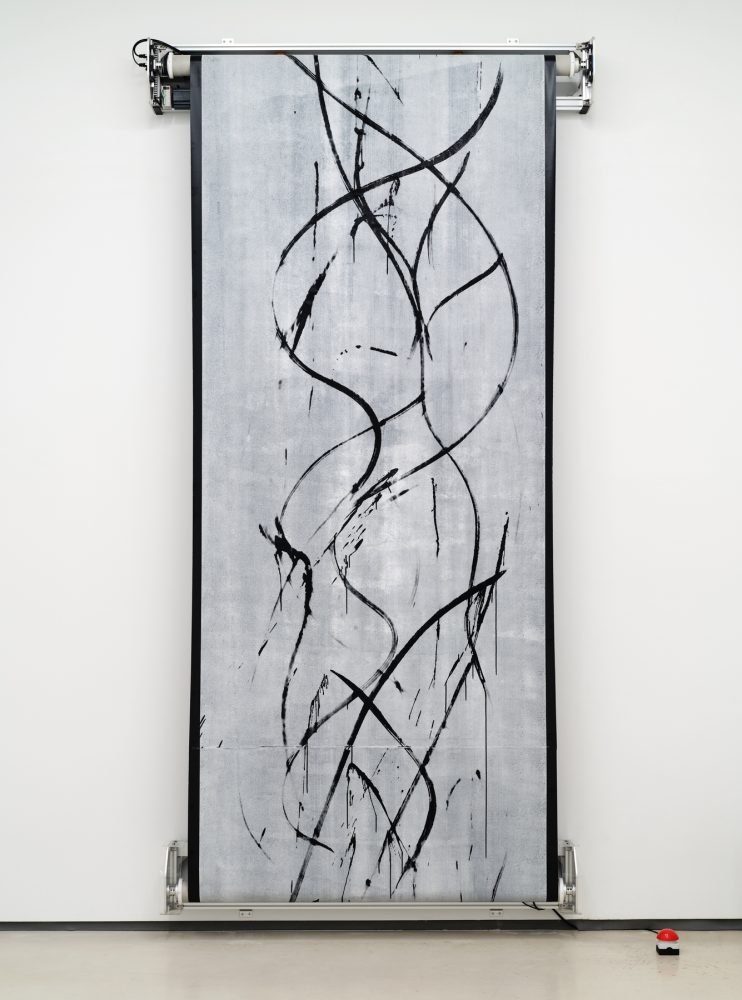
書法習作 003
Aluminum extrusion, motor, PLC, roller, water-writing cloth, brush, inkstone, water,
H360 × W198 × D24 cm, 2024
Calligraphy Study 003 is a vertical, interactive mechanical installation around 2.5 meters in height. Viewers are invited to dip a calligraphy brush in water and write on a special water-writing cloth, where the brushstrokes initially appear as dark traces resembling ink but gradually fade as the water evaporates. The cloth is suspended like an unfurled scroll, held taut by mechanical structures at both ends, merging the traditional form of calligraphy with modern mechanical design. While the surface of the cloth moves slowly, viewers can accelerate its motion by stepping on a control device. This interruption makes sustained writing nearly impossible, as the body is pulled along by the hastened speed, generating a sense of pressure and loss of control. Through this experience, the work confronts viewers with the irreversibility of time and the transience of culture in constant flux.
The piece extends from Wu Chi-Tsung’s earlier Calligraphy Study 001 series, first presented at the Hengshan Calligraphy Biennial. In that work, the artist used a modified treadmill as the writing surface, attempting to copy Wang Xizhi’s Letter of Loss and Confusion. The treadmill’s constant motion turned writing into an impossible act, symbolizing the rapid pace of contemporary life and the difficulty of maintaining concentration and continuity in calligraphy. It also pointed to the gradual decline of traditional culture and ways of living amid modernization. Continuing this central inquiry, Calligraphy Study 003 binds the viewer’s writing to time itself, as the fading and lingering water marks become an inseparable part of the work. These vanishing marks never truly disappear; instead, they seep into time in another form, carrying with them an indelible memory.
《書法習作 003》是一件垂直懸掛、高約 2.5 公尺的互動式機械裝置。觀者可使用毛筆沾水在水寫布上書寫,筆跡在表面形成如墨般的深色痕跡,卻隨著水分蒸發而逐漸淡去。水寫布由上下兩端的機械結構固定,如同一幅展開的卷軸,將傳統書法的形式與現代機械結構結合。原本緩慢移動的布面,可因觀者踩踏控制裝置而加速,使書寫難以持續,身體被速度牽引,產生無法掌握與停留的壓迫感。作品藉此引導觀者以身體經驗直面時間的不可逆,並感受文化在流變中的無常。
此作延伸自藝術家早期的《書法習作 001》系列。該系列首次於橫山書藝術雙年展展出,吳季璁在改裝的跑步機上臨摹王羲之《喪亂帖》,以跑步機的速度隱喻當代社會的急速變遷,突顯在高速環境下,書法的專注性與連續性難以維持,也隱射了傳統文化與生活方式在現代化進程中逐漸式微的處境。延續這一核心命題,《書法習作 003》將觀者的書寫行為與時間流逝結合,讓水跡的淡去與殘留成為作品的一部分。那些漸褪的筆痕並未真正消失,而是以另一種形式滲入時間,延續著不可抹去的記憶。
書法習作 002
Single-channel video, 2023
書法習作 001
Single-channel video, 2min, 2022
Wu Chi-Tsung debuted his new work series, the Calligraphy Series, at 2023 Hengshan Calligraphy Biennial. Co-organized by Taoyuan Museum of Fine Arts and Hengshan Calligraphy Art Center and co-curated by Wu Chao Jen Philip and Chen I Tso, the inaugural biennial, titled “Era of Principle and No Principle Interwoven”, is centered on the development and future prospect of Chinese Calligraphy in the context of contemporary art.
‘In this video, a length of a paper is attached to a modified treadmill. After turning the treadmill on, Wu uses a brush to write on the moving paper. As he attempts to transcribe the famous ” The Letter of Loss and Confusion” ( Sangluan Tie) by Wang Xizhi, the speed of the paper’s motion makes writing futile as all characters turn out to be entirely illegible. The speed of the treadmill represents the rapid changes in the spatiotemporal setting. Not only is the brush unable to cope with the circumstances, but it is also incapable to engage in a meaningful conversation with the paper. ‘ (Quoted from curatorial statement by Hengshan Calligraphy Art Center)

書法習作 001
Single-channel video, 2min, 2022
吳季璁新作《書法習作》於2023年首屆橫山書藝雙年展發表。本作是吳季璁特別為本此展覽的新創作品。雙年展由桃園市立美術館與橫山書法藝術館合辦,由策展人吳超然、機構策展人陳俋佐共同企劃,以《法與無法交織的年代─書法作為一種視覺形式》為主題,聚焦當代藝術語境下書法藝術的未來。
「本作是吳季璁特別為本此展覽的新創作品。在這件錄像中,他在改裝的跑步機上貼上一張紙,啟動跑步機後,用毛筆在滾動中的紙上書寫。他企圖臨摹王義之的《喪亂帖》,但因為速度的開係,最終無法成宇。這個創作中跑步機的速度指涉了時空環境下的轉變,毛筆不僅難以帤駁,更無法和紙張產生有意義的對話。」(節選自橫山書法藝術館策展論述)
書法習作 001,單頻道錄影
2022