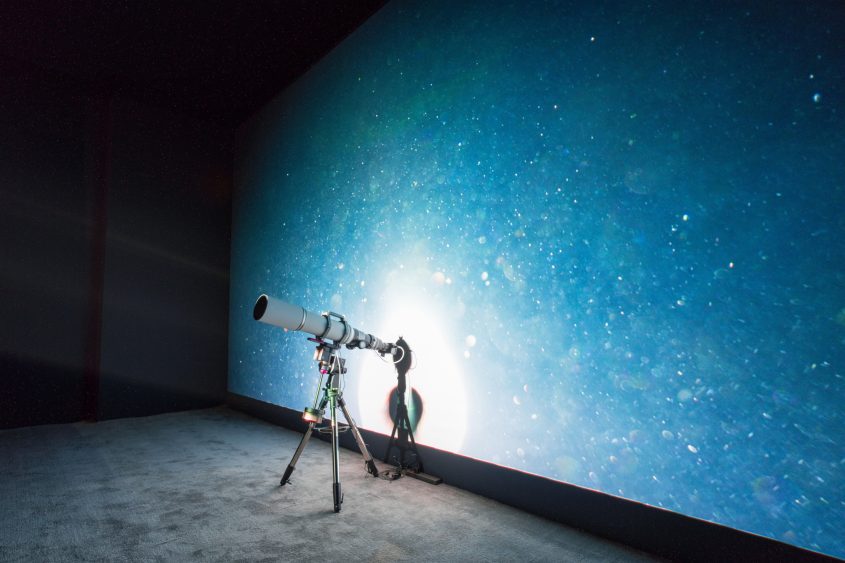
《灰塵 002》於利雅德光之藝術節展覽現場
Wu Chi-Tsung’s installation Dust 002, previously presented at Art Basel Unlimited 2023, was exhibited in Riyadh and Taipei from late 2025 to early 2026, continuing his exploration of light, image, space, and perception across different urban and curatorial contexts. Dust 002 is itself a real-time image installation: a camera is directed toward the beam of a projector, while dust particles suspended in the air reflect the projector’s light much like the moon reflects sunlight. As viewers move through the space and disturb the air, the image changes instantly, generating an evolving relationship among the artist, the viewer, the moving image medium, and chance. Through the camera, the work constructs a viewing system that relocates human vision into the world of dust, yet what appears before us feels almost like another universe.
In 2025, internationally active new media curator Li Zhenhua invited Wu Chi-Tsung to present Dust 002 at Riyadh’s annual light festival, Noor Riyadh. The organizers described the work as a form of “living drawing” and “calligraphy” written by air and chance: dust drifts through the beam of light, its paths briefly appearing before quickly dissolving, like a transient language composed jointly by motion and accident. In designboom’s coverage, the work was likewise described as transforming light into a subtle atmospheric movement, allowing particulate illumination to drift across the surface like suspended dust.
In the Taipei Astronomical Museum’s 2026 New Year special exhibition, In the Interstice of Light, Dust 002 entered an entirely different yet deeply compelling context. This marked the museum’s first exhibition centered on art curatorship. Rather than focusing on the transmission of knowledge or any single scientific principle, the exhibition pointed to a simple yet profound proposition: light not only renders things visible, but also reveals what would otherwise remain unseen. Curator Makoto Lin and Head of Exhibitions Hsieh Hsiang-Yu brought together contemporary art, astronomy, and physical thought in an effort to open up the perceptual boundary between the visible and the invisible. Wu noted that, although this was the museum’s first attempt at presenting an art exhibition, the institution’s respect for both the artist and the work resulted in an installation that far exceeded the presentation in Riyadh.
And yet, this work—well known to many, seen by some at Art Basel Unlimited, but still unseen by most audiences in Taiwan—did not make its Taiwanese debut in an art museum. Instead, it was first presented in a space shaped by science and education: the Taipei Astronomical Museum, where it was newly encountered and reinterpreted.
Within the exhibition, Dust 002 was placed at the deepest point of the gallery and, for the first time, presented as a monumental vertical projection, making the act of viewing feel closer to gazing up at the night sky. The originally microscopic dust particles, captured within a real-time feedback system composed of an astronomical telescope, a camera, and a projector, were elevated to a visual scale reminiscent of stars and the cosmos. As viewers entered the gallery, their bodily movement stirred the air, causing the dust image to shift; when they stood still, the image gradually settled. In this way, the work made one aware of how one’s own presence is constantly affecting the surrounding world, while also offering an experience that was at once scientific, poetic, and quietly romantic.
The presentation at the Taipei Astronomical Museum also opened up another unexpectedly rich layer of interpretation. Hsieh Hsiang-Yu observed that when a finger was brought close to the lens, the light spots would reveal the shadow of the finger. Most of these shadows appeared upright, while a smaller number appeared inverted. This phenomenon depends on whether the dust particles are positioned in front of or behind the focal plane, resulting in either an upright or inverted image. Such close observation then led to discussions of the scientific principles involved, which Wu found especially fascinating, and further encouraged his hope for future collaborations that bring together scientific phenomena and educational outreach.
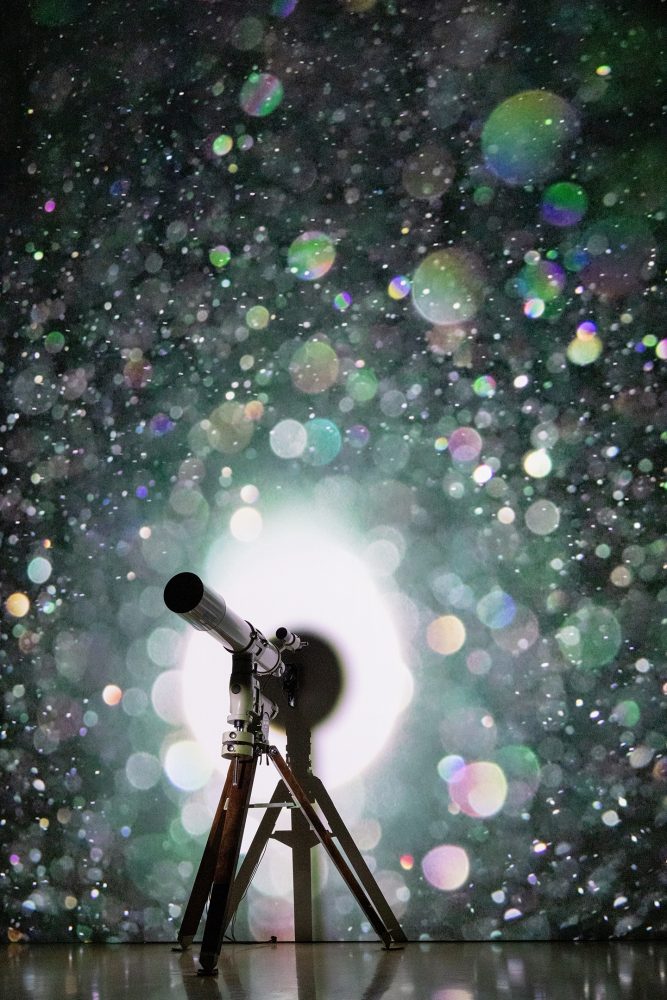
《灰塵 002》於臺北市立天文科學教育館展覽現場
吳季璁曾於 2023 Art Basel Unlimited 展出的裝置作品《灰塵 002》,2025 年底至 2026 年初,先後於利雅德與臺北展出,從不同城市與展覽脈絡中,持續開展他對光、影像、空間與感知的探索。《灰塵 002》本身為一件即時影像裝置:攝影機對準投影機的光源方向拍攝,空間中的灰塵會反射投影機的光線,如同月亮反射太陽光。隨著觀者的移動擾動空氣,畫面也瞬間改變,形成藝術家、觀者、影像媒體與偶然性之間持續生成的關係,如同透過用攝影機建立一套觀看系統,把人的視角放到灰塵的世界,卻彷彿看到另一個宇宙。
2025年,活躍於國際新媒體藝術領域的策展人李振華,邀請吳季璁參與利雅德一年一度的「光之藝術節」(Noor Riyadh)展出《灰塵 002》。官方將這件作品描述為一種由空氣與機運寫成的「活的素描」與「書法」:塵埃在光束中漂浮,路徑短暫顯現又迅速消散,像是運動與偶然共同書寫出的瞬時語言;designboom 的報導中,也形容它把光轉化為一種細微的大氣運動,讓顆粒般的光在表面漂移,如同浮游的微塵。
而這件很多人聽過、在 Art Basel Unlimited 看過,但台灣觀眾卻一直無緣親見的作品,在台灣的首展並非在美術館展出,而是在一個屬於科學與教育的場域——臺北市立天文科學教育館中,被重新認識與理解。
在臺北天文館 2026 跨年藝術特展 《光的間質》 中,《灰塵 002》被放進另一個非常不同但迷人的脈絡裡。這是天文館首度以藝術策展為核心所推出的特展,不以知識傳遞或單一科學原理為目標,而是揭示一個簡單的道理:光既使物可見,也使不可見之處得以顯影1。策展人許戊德(Makoto Lin)與天文館展覽組組長謝翔宇,將當代藝術創作、天文與物理思維並置,嘗試透過作品去打開「可見」與「不可見」之間的感知邊界。吳季璁表示此次展覽雖是天文館首度嘗試藝術展,但由於館方對藝術家和作品的尊重,作品效果遠超越在利雅德的展出。
展覽中,《灰塵 002》被安排在特展室最深處,並首度以巨幅垂直投影呈現,使觀看姿態更接近仰望星空;原本微觀的塵埃,在天文望遠鏡、攝影機與投影機構成的即時回饋系統中,被拉升為近似星空與宇宙的視覺尺度。當觀者走入展間,身體移動帶動氣流,灰塵影像便隨之改變;當觀者站定,畫面又慢慢安定下來讓人意識到自身的存在如何無時無刻影響著周遭的世界,也為觀者帶來一種既科學又詩意浪漫的獨特體驗。
這次在天文館展出,也意外打開了《灰塵 002》另一層有趣的閱讀方式。謝翔宇觀察到:當手指靠近鏡片時,光斑裡會出現手指的影子,大部分影子是正的(和手指同向),少部分則呈現反向。而這樣的現象取決於灰塵顆粒位於焦點的前方或後方,而形成了正像或反像。如此細膩的觀察,進而延伸出科學原理的討論,讓吳季璁感到十分有趣,也希望未來能有更多結合科學現象與教育推廣的展覽合作。