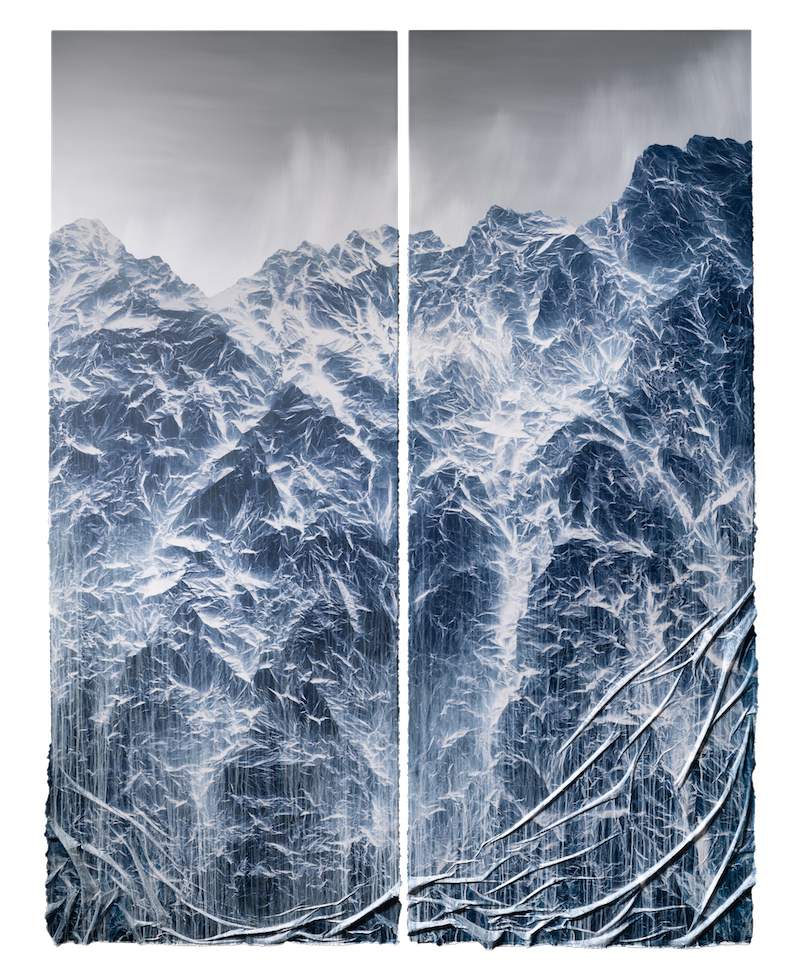
氰山集之二百六十六
240 x 90cm x 2 panels, 2026
Galerie du Monde|Booth 1D33
VIP Preview|Mar 25-26, 2026
Public Days|Mar 27-29, 2026
Venue|Convention & Exhibition Centre, Hong Kong
gdm 爍樂(世界畫廊)|1D33展位
貴賓預展|2026年3月25日至26日
公眾展期|2026年3月27日至29日
會址|香港國際會議展覽中心
Wu Chi-Tsung’s new work, Cyano-Collage 266, is currently on view at Galerie du Monde’s booth at Art Basel Hong Kong. As one of Wu’s most significant ongoing bodies of work since 2015, the Cyano-Collage series transforms the brushwork and texture strokes of traditional Chinese painting through the language of photogram. Using Xuan paper, photosensitive chemicals, sunlight exposure, and collage, the series constructs a visual space suspended between shanshui, landscape, and photographic montage, while seeking to carry forward the aesthetic spirit of traditional art through a contemporary artistic form.
In this new work, Wu Chi-Tsung brings the Cyano-Collage series to a new stage. Within the series, the traces of light and shadow produced by the wrinkled paper remain relatively abstract; it is the skyline that gives shape to the viewer’s perspectival imagination of a two-dimensional space. In Cyano-Collage 266, however, the deliberately preserved fold along the lower edge of the work expands that spatial dimension beyond the image itself and into physical reality. In doing so, the work also extends Wu’s recent inquiry—from the Wrinkled Texture series to Wrinkled Texture: Fading Origin—into the differences between analog and digital reproducibility, while attempting to preserve and make visible the unique, unrepeatable moments that emerge in the process of creation.
Wu Chi-Tsung notes, “In the past, I tended to resolve my works more cleanly, using purified form to articulate an idea with greater clarity. Recently, however, I have been thinking somewhat differently. I want the material itself, as well as the process of making, to carry meaning. In this work, I have tried to preserve many of the traces left by the making process, allowing the wrinkles of the paper and the naturally flowing watermarks to become part of the composition.”
For Wu, whether a work has truly reached completion often depends on whether the viewer’s gaze can move freely within it. In this sense, the work recalls Guo Xi’s Northern Song painting theory, articulated in Lofty Message of Forests and Streams (Linquan Gaozhi), in which landscape is conceived not as a fixed image but as a space that one can reach, appreciate, wander through, and dwell in. What emerges, then, is a space in which both vision and imagination may move freely. The space within the work is generated not only by the moment of exposure recorded in the image, but also by the shifting light across the undulating material surface in the present moment of viewing, as well as by the traces left behind through the movement of water. In encountering Cyano-Collage 266, the gaze is first drawn into the depth of the image through sky, mist, and mountainous form, then extends along the direction of the flowing marks—at times descending like mist cascading downward, at times circulating upward along the folds of the paper. These movements respond not only to vapor and mountain form, but also to the actual creases of the material surface, continually shifting between illusion and physicality.
While Wrinkled Texture: Fading Origin foregrounds the loss of information inherent in analog reproduction, Cyano-Collage 266 returns to the same core question by another route: when the image no longer functions merely as representation, but becomes entangled with time, chance, surface folds, and perceptual experience, the work is no longer simply photography, nor merely painting, but a site in which vision itself continues to unfold. For Wu Chi-Tsung, this new work marks an important milestone within the Cyano-Collage series. It not only extends the series’ underlying dialogue with Eastern aesthetics, but also opens up a new conversation between photography and painting. This quality of moving across distinct yet overlapping fields—image-making, painting, ink traditions, conceptual practice, and new media art—is not unique to Cyano-Collage alone, but is in fact one of the defining characteristics of Wu’s broader artistic development and way of thinking.
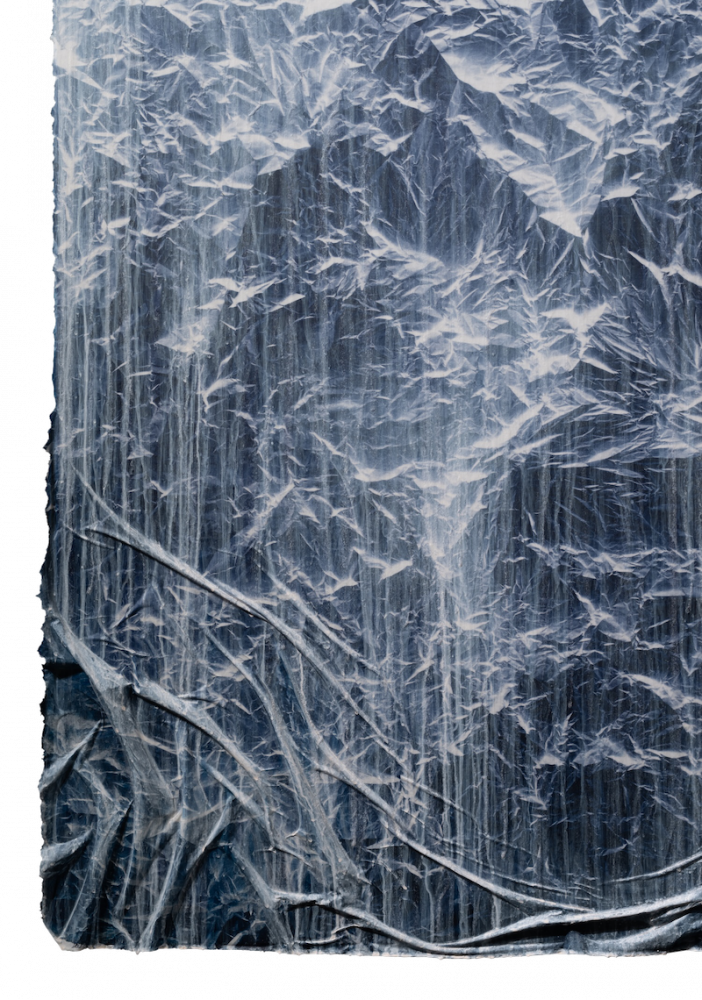
《氰山集之二百六十六》左下角局部照
吳季璁的新作 《氰山集之二百六十六》,正於巴塞爾藝術展香港展會(Art Basel Hong Kong)gdm爍樂畫廊中展出。作為自 2015 年起持續發展至今的重要創作系列,《氰山集》以氰版直接攝影(photogram)替代傳統書畫中的筆墨:以宣紙、感光藥劑、日曬曝光與拼貼,建構出介於山水、風景與攝影蒙太奇之間的視覺空間,希望藉由當代的藝術形式,傳承傳統藝術中的美學意境。
在此件新作中,吳季璁進一步將《氰山集》推向新的層次。該系列中,紙張皺摺形成的光影痕跡相對抽象,其實是由天際線界定了觀者對於二維空間的透視想像;而在《氰山集之二百六十六》下方刻意保留的紙張摺痕,讓空間從影像維度推展到實體。這樣的處理,也進一步推進了他近年從《皴法習作》到《皴法習作:消逝的原件》中關於類比與數位複製性差異的討論,試圖保留和呈現出創作過程中每個獨一無二的當下。
吳季璁表示,「我以前會將作品收得更乾淨,藉由純粹的形式清楚闡述觀念,但近期我有些不同的思考,希望讓材質和創作的過程都能有其意義。在這件作品中,我試著保留許多製作過程中的痕跡,讓紙張的皺摺與自然流淌的水痕成為構圖的一部分。」對他而言,一件作品是否完成,往往取決於觀者的視線能否在其中自由流動,如同北宋郭熙在《林泉高致》中提到的「可行、可望、可遊、可居」,形塑一個讓視線與精神得以投射、游移與停留的空間。於作品中的空間不僅來自影像所再現的曝光當下,也來自觀看當下材質表面的起伏的光影,以及水性流動所留下的痕跡。欣賞《氰山集之二百六十六》時,目光會先被天空、雲霧與山勢引入畫面深處,再順著流痕的方向延伸,有時像雲霧往下漫延,有時又順著皺摺向上循環,不僅和水氣、山形,也與物質表面的真實摺痕彼此呼應,在虛實之間不停切換。
若說《皴法習作:消逝的原件》更明確處理了類比複製中的訊息耗損,那麼《氰山集之二百六十六》則像是從另一條路徑回到同一個核心命題:當影像不再只是再現,而與時間、偶然性、表面皺褶與感知經驗交纏在一起時,作品便不再只是攝影,也不只是繪畫,而是一個讓觀看持續生成的場域。對吳季璁來說,這件新作是《氰山集》系列中一個重要的里程碑——它不只延續系列原有的東方美學脈絡,也打開了攝影與繪畫之間的新對話。這種橫跨影像、繪畫、水墨書畫、觀念、新媒體藝術等不同範疇的特質,不只存在於《氰山集》,也是吳季璁整體創作發展與思維的一個鮮明特質。